Saturday, November 28, 2009

Friday, November 27, 2009 – Barcelona, Spain – Cloudy – Drizzly - 50s

Slept until 10:00 AM (the last time I slept this late was in High School) – since no one slipped us any drugs, I can only attribute this to the lack of any light in our room.  So now, we are more “jet lagged” than yesterday.

Today’s plan is to do the walking tour of the “Gothic Quarter”, a multi-square block area of medieval buildings and narrow streets reachable from Las Ramblas.  We passed by the Placa de Catalunya to check out another of the fantastic fountains.

HMT Plaza Catalunya

This was a peaceful fountain, where water gently flowed over the edge of what resembled a large pool.

A left turn off Las Ramblas takes you from the bustling wide pedestrian showplace to the narrow streets (still full of people) of the Gothic Quarter.  Our first stop is Santa Maria Del Pi, a church built over a period of 100 years (starting in the early 1300s).

Esglesia De Santa Maria Del Pi Santa Maria De Pi

Esglesia De Santa Maria Del Pi

The church is an example of Catalan Gothic.  Surrounding the church are narrow streets with upscale shops and small cafes.

Not far from the Placa Pi is the Roman Wall and Barcelona Cathedral complex.  The Roman Walls are the remains of the Roman City of Barcino.  The Cathedral complex is entered through one of the ancient gates

Roman Wall - Gothic Quarter

Ellen at the Gothic Gate (the Roman Wall is on the left)

The cathedral is visible down the long, narrow street.

 Roman Wall and Cathedral

We decided not to take the tour of the Cathedral but I did manage to snap a picture of the courtyard

Cathedral Courtyard

The next destination was the Call – the old Jewish Quarter – home to Jews from the 11th century until last 1391, when the area was attacked and destroyed.  The streets and architecture are essentially the same as the rest of Gothic Barcelona

Jewish Quarter

Ellen standing in the streets of the Call 

until you come across this plaque on one of the street corners

Entrance to the Call

The Synagogue was discovered accidently when reviewing old tax records (according to the guide) – this building paid no taxes (just like today) and was not a church.  The entrance to the Synagogue is very small (about Ellen Size - 5 ft tall)

Synagogue Entrance 

Inside the structure is an archeological dig representing the four layers of walls

various walls

The boulders are from the 3rd and 4th centuries (basically Roman); the middle stones are from the 13th to 15th centuries and the upper bricks from the 17th and 18th centuries.

There were several other artifacts in the Synagogue including a menorah

artifacts in shul

and some Torahs

Torahs from Morocco

These items are not from the original Synagogue (they are clearly too recent) – the Torahs are actually from the 18th century from Morocco (they were donated to the Synagogue).

The next stop was the Barcelona Cathedral (under repair like most sacred places seem to be)

Barcelona Cathredal

This iteration is from the 13th century, with the facade (under restoration) added in the 19th century.

We caught another view of this magnificent building as we departed the Gothic Quarter

cathedral

Barcelona Cathedral

Due to the late start on this day, our walking tour is just about over as we head back up Las Ramblas.

Thursday, November 26, 2009

Thursday, November 26, 2009 – Barcelona, Spain – Sunny – Mid 70s

(Updated and corrected)

The jet lag is slowly departing although I did get up in the middle of the night and didn’t know where I was. 

Happy Thanksgiving – the hotel must be aware of this as they are serving Turkey on the buffet today (lots of Yanks are staying here).

We have found that the best way to get back on local time is to literally walk it off.  Today, we are planning to head down Las Ramblas to the Statue of Christopher Columbus and the Marina.  It’s a good opportunity to check out the shops and the architecture.  The route has both classic and modernist style buildings.  This building at the corner of Las Ramblas and Mallorca is a good example of classic architecture.

Mallorca and Las Ramblas Architecture

The Plaza Catalunya is pretty impressive in the daytime even though the fountain is not running

Plaza Catalunya

Ellen – Plaza Catalunya

The Plaza is massive and serves as the entrance to Las Ramblas or the multi-block pedestrian walkway

Las Ramblas

Entrance to Las Ramblas from the South

The center of Las Ramblas is jam packed with pedestrians, flower shops and numerous “human statues”.  These statues range from the very bizarre (“mythical creatures”) to more mundane types (the standard robot).  The best one we saw was a fellow covered head to toe with fruits and vegetables who blended seamlessly into a produce stand (I didn’t get a picture since it’s pay and snap).

Continuing down Las Ramblas, we encountered more amazing buildings – one with frescoes (or reliefs for those in the know)

Building with frescoes

and another with a decidedly Asian motif, complete with dragon and parasols

Building wth Asian motif

Las Ramblas ends at the Mirador de Colon.  The Statue of Christopher Columbus is very impressive – over 150 feet tall with a small elevator that takes you to the top for a neat view.

Columbus statue at the Marina

Chris, for sure, is at the top, but all around the statue are figures that no doubt have some connection to CCs voyages.  I believe Columbus met with Ferdinand and Isabella in Barcelona upon his return from the New World. 

If you look west from the Marina, you can see a Montjuic,

looking west from the Marina

a hill on which the Estadi Olimpic is located.  This stadium was to be used for the 1936 Olympics (which went to Berlin – go Jesse) but was repurposed for the 1992 Barcelona Olympics.

The MareMagnum Shopping Mall is located at the end of a small footbridge.  It has all the stores you would expect from an upscale mall.  We did manage to take an interesting shot of ourselves reflecting in the mirrored facade

Reflections II

Can you spot us?  The tables just below us are from a restaurant.  Neat, huh?

Adjacent to the Mall is the Marina Port Vell.  The marina is literally packed with boats.

Marina Port Vell

You can get a good view of the Columbus Statue and the Barcelona Maritime Museum from the Marina.

Maritime Museum

From the Maremagnum, you can see the World Trade Center (one of about 40 around the world)

World Trade Center and statue

I don’t know what that statue is doing in the middle of the inlet but there are two of them. 

Following lunch, exploration continued.

Gracia Street is the street parallel to Catalunya; this street is part of the Gaudi tour and contains a number of his works.  One great, oft cited, example is the Casa Battlo

Casa Battlo 

Casa Battlo

whose roof lines represent St. George’s battle with the Dragon (you can see the serrated dragon’s tail) and whose balconies resemble masks (see the eye holes) and jaws (teeth are visible).

Another fine example of architecture is right next to the Gaudi.  This is the Amatller House built in 1900.  The structure gets a lot of attention being adjacent to the Casa Batllo.

Gaudi Casa Batllo

Casa Amatller

Another famous work by Gaudi, La Pedrera, is a few blocks away on Passeig de Gracia. 

Gaudi 

After dinner, we went back to Passeig de Gracia to see the architecture at night.  The buildings are lit and spectacular at night. 

Casa Battlo at night

Casa Battlo under the lights

La Perdrera at night

La Pedrera at night

Both Gaudi sites had some kind of special event going on – camera crews, crowds, and special waiters at the ready.   Maybe Barack was taking Michelle for a tour of the sites followed by dinner – isn’t it date night tonight?

An hour later we are back in our room – enough walking for one day.

Wednesday, November 25, 2009

Transatlantic Cruise – Voyager of the Seas – November 29 – December 13, 2009

Tuesday, November 24, 2009 -  Travel Day

It’s drizzling and dreary outside.  The weather is starting to feel like Winter (snow is forecast for Thanksgiving).  While we are regrettably missing Thanksgiving with the family this year, we are booked on the Voyager of the Seas from Barcelona, Spain to Galveston, Texas (really). 

Our flight to London departs at 10:00 PM so we have additional time to spend with the kids. Our plane, a 777 brought in for this flight (no passengers deplaned at O’Hare,

dark and rainy our plane (Small) 

Our plane – wet with warning lights

developed an electrical problem.  The pilot said the maintenance crew “reset” the electrical system and all of the fault lights went out.  Good to go (he thought nervously) and only about 30 minutes late.

Someone explain this to me – at about midnight, dinner was served, which, as I see it, a sure fire way to ensue that you do not sleep during the flight.  Not helping was the multi-decibel role of those 777 engines, but no real sleep was had.  As usual, dawn over the Atlantic Ocean was a sight to behold

Sunrise atlantic ocean (Small)

Sunrise over the Atlantic Ocean

The flight was relatively smooth. I was actually pleased to see the “fasten seat belt” light come on during the flight because that meant that someone was awake in the cockpit or logged off of Face Book long enough to hit the light.  It’s the little things that count when you’re flying. 

We were a bit tired but happy to be an hour from London

almost in London - no sleep (Small)

Sitting in the exit/bulkhead row really help with the deep vein thrombosis issue.

Our connection with British Air went well even though it was tighter than usual  Soon we boarded a bus to take us to our plane – first for me

our bus to our BA flight 

If that wasn’t enough, we actually walked up a set of portable stairs to our plane

no jetway (Small)

I felt like giving the “Presidential Wave” at the top of the stairs but it was chilly and I wanted to get to my seat.

I love flying British Air.  The flight attendants are always courteous and the pilots give the shortest (and mostly unintelligible) announcements.  The flight was bumpy but the sunset over Barcelona bookended the day

sunset in Barcelona (Small)

We haven’t been back to Barcelona since 1997.  The airport looked band new with these great un-escalators (they were a moving ramp). 

Then everything came together:  Our luggage came right out (both bags); passport control took 30 seconds; For 5 Euros we took the Aerobus straight to the Plaza Catalunya (where our hotel is).  The city is just fantastic; one example, the fountain at the Plaza Catalunya

Foutain - Plaza  Catalunya (Small)

Fountain – Plaza Catalunya

We are staying at a very nice baroque style hotel:  Hotel Continental Palacete.  They have a 24 hour buffet (including beer, wine, and lattes) so we tried some tapas and sweets.  I  don’t think we will need to eat anywhere else while we are here.

Monday, August 3, 2009

Rome, Italy – Post Cruise – These Boots Were Made for Walkin’

Sunday, July 19, 2009 – Rome, Italy – 91F – Sunny

Another beautiful but warm day in Rome – shade had better be abundant because we are planning another grand walking tour.  This one starts at the Vatican and covers some of the major sites not yet visited.

Per plan, we took the Metro to the Ottaviano Stop, the closest one to Vatican City.  We didn’t need to ask for any directions – we just needed to follow all the faithful.  We entered the complex from Via Ottaviano through a massive gate

Rome - Via Ottaviano Entrance to Vatican

Vatican Gate – Via Ottaviano

Once inside, the size and grandeur of the Vatican was simply amazing.  Piazza San Pietro – St. Peter’s Square (not actually a square but many squares in Rome are not).  The square can accommodate upwards of 400,000 people but this day contained a modest group of tourists mostly (you can tell by all of the camera’s clicking).  By the way, the square is lined with over 280 Doric Columns (no, I did not count them).
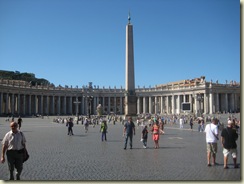
Rome- Vatican Square

St. Peter’s Square – Vatican City

Somewhere among these columns is Ellen – A chance to play “Where’s Ellen”

Rome - wheres Ellen

On occasions when the square is at capacity and some of the attendees cannot directly see the proceedings, the Vatican has provided Diamond Vision type Screens at locations throughout the square.  The Vatican is clearly tech savvy.

Rome- Vatican old and new

Large TVs so everyone can see

Basilica San Pietro – St. Peter’s Church – built to recognize the Saint’s burial site – is recognizable world wide.

St. Peters Basilica

St. Peter’s Church

Just so no one thinks I took this picture from Wikipedia

Vatican - E and Me

Ellen and me at the Vatican

No, my face is not obscured because I’m in the Witness Protection Program – it was hot and humid and the hat was essential equipment.

Although some folk believe the Sistine Chapel is in the Basilica, it is actually in the Vatican Museum.  We did not opt for the museum as we have an aversion to very long lines; we did enter a line headed for the Basilica.  As we made our way to the entrance (through many checkpoints) – I had only one thought on my mind - “Are my shorts over my knees” – there were many people wearing shorts but they seemed to meet the decorum requirement.  A couple of tugs and the shorts passed muster at the entrance. 

For some reason, this line did not go into the Basilica but instead it wound through an exhibit area containing various historical artifacts and items from the Vatican’s long history.  Included were sarcophagi of various past popes – I did manage to snap a picture before we were told “no cameras” (there were no signs at the entrance about cameras and one of our earlier guides said pictures were allowed in the Basilica).

Vatican - Pope Sarcophagus

Sarcophagus of a past Pope

The Italians in the crowd had the chutzpah to snap pictures right in front of the security personnel (even after they had been warned not to do so).  Perhaps they understand the system better than we do.

A visit to the Vatican would be incomplete without a picture of the famed Vatican Guard – decked out in their familiar garb; this one moved so little I thought he was a mannequin (and maybe he was).

Rome - Vatican Guard

Vatican Guard

Exiting the Vatican complex, our next stop on the walking tour is the magnificent, Castel Sant’Angelo, located along the banks of the Tiber River.

Rome - Castel Sant'angelo

Castel Sant’Angelo

This structure, built by the Emperor Hadrian in the 2nd Century AD, has been a mausoleum, fortress (complete with moat, which still exists), and summer palace for the past Popes.  Today, the street near the Castle is lined with souvenir vendors.

Looking back from the Castle – down the Via Della Conciliazione - one gets a great view of St. Peter’s Basilica as well as the grand architecture of the area.

Vatican from Castel Sant'angelo  

The view from Castel San't’Angelo

We cross the Tiber River at the scenic Ponte Sant’Angelo

IMG_3002

View from Ponte Sant’Angelo

We arrive at the our destination, Piazza Navona.  In 86 AD, the Emperor Domitian used this area as a stadium; the site was scavenged for its stone and then restored during the Renaissance.  Today, the Piazza is a pedestrian area lined with restaurants and home to scenic fountains, an architecturally interesting church, and a magnificent obelisk.

Rome - Plaza Navona

Piazza Navona

We managed to find someone to take our picture against one of the beautiful fountains.

Rome - Plaza Navona and us 

Just three or so blocks from the Piazza Navona stands one of the most impressive and best preserved ancient monuments in Rome – the Pantheon

Rome - Pantheon 

The Pantheon

The Pantheon was built in the early 2nd Century by the Emperor Hadrian.  It has held up well during the centuries due to the use of granite by its builders.  Its name suggests that it was originally a temple to all of the gods of Rome; it was changed into a church (Santa Maria ad Martyres) at the beginning of the 7th Century.  The dome is the largest in the world just edging out St. Peters by a couple of feet (how did they know?).

The dome has a circular opening so it is possible for rain to soak the  floor – a drain has been installed to deal with any water.  Inside the Pantheon, it was wall to wall people. By the way, the obelisk in front of the Pantheon is not about to fall – an optical illusion.

You cannot visit Rome and not see the Pantheon – mission accomplished.

Our final destination was the Jewish Ghetto Area; we had visited this area and its magnificent Synagogue before the cruise.  However, another tasty kosher hamburger seemed like a worthy goal.  Walking is the only practical way to get there as the Piazza Navona – Pantheon area is devoid of M Stops; it is actually a shorter walk to the Ghetto than to a train stop. 

We headed toward the Tiber River but the street names (which change every block in some cases) confused us enough to ask for directions.  A policeman gave us directions to the Tiber – problem solved. Not.

The problem is the Tiber river and the way it winds its way through Rome.  When we got to the river, we found ourselves back at the Castel Sant’Angelo.  So five bridges later, and about an hours walk, we arrived at the FK Kosher fast food restaurant in the Ghetto.  At least, we had worked up a good appetite.  Most importantly, FK Kosher had a washroom (it’s such a small place, I would have bet against this). 

We refueled both body and spirit with a hamburger and a double burger (for me), fresh fries (better than McD) and a mini-Coke Lite.  The way home would be easier (relatively) since we were going to catch the metro at the Circo Massimo M Station.  Still, this required our walking up and then down the Aventine Hill – another of the seven hills of Rome.  A short Metro ride home and this day of wearing down our New Balances was over.  The count: 19, 800 steps (over 8.5 miles).  These boots really did some walkin’ this day.

Monday, July 20, 2009 = Rome, Italy – 85F – Sunny

We had intended to see a bit more of this great city but the heat and our tired selves decided otherwise.  We strolled about the area near the hotel and had our last lunch in Rome at one of the neighborhood restaurants.  At about 3 PM, we grabbed our luggage from hotel storage and made our way to the M Station.  This 1 Euro trip would take us to a train station adjacent to one of the subway stops.  Then 5.5 Euros would take us to Fiumicino Airport.  All went well until we were informed that the earlier train (not ours) trains to the airport could not leave the station due to trouble down the line. 

Instead of waiting for our train, we hopped on the earlier one (which was stuffed with passengers and luggage) and about 20 minutes later, the train started moving.  It was a Tower of Babel experience with all of the languages spoken by the folks on the train.  In about 30 minutes we were in the British Airways terminal at Fiumicino Airport.  We used self check-in (scanning our passports as ID – very cool) and then checked our bags through to Chicago.  Our Airbus A321 did its usual scary fast and noisy roll and quick rotation and soon we were over the Tyrrhenean Sea (I didn’t realize that the airport was that close to the water).  It reminded me of take offs at LAX.

Over the Tyrrhenean Sea

 Climb out from Rome

Looking down we could see a cruise ship departing from Civitavecchia (look carefully)

Rome climbout - cruise ship

Another cruise ship starts on its voyage 

Kudos to British Air for supplying meals on a flight less than two hours long (also had food on the earlier BA flight to Rome).  They always have a veggie option and the cream cheese and veggie sandwich was tasty. 

As we approached London, I noticed a strange rainbow effect off the starboard wing – can’t explain it but it wasn’t a reflection off the window.  It disappeared while I was looking at it.

Heathrow - Look to the Rainbow

Look, look to the rainbow

The approach to London was magnificent with the Thames River, Millennium Eye and Parliament clearly visible.

Heathrow - London 2

On final approach to London

We found the right shuttle transportation and successfully arrived at the Holiday Inn, London Heathrow. 

Tuesday, July 21, London, England – 60F – Rain

It’s time to go home.  A quick breakfast in the room, then a short shuttle ride to the Terminal and soon we were on our Boeing 767, which would take us to Raleigh-Durham International Airport – then a connection would take us to Ohare.

The 767 climbed out through the London rain and soon we were over the clouds

IMG_3057

Climb out from London

The Transatlantic flight was relatively smooth and we were pretty comfortable in our roomy exit row seats.   The plane entered North America over Newfoundland and flew down the East Coast on its approach to Raleigh-Durham.  Our short layover in Raleigh gave me a chance to check a-mails (free Wi-Fi) and catch up on things.

The short flight on the Super 80 to Ohare was smooth and soon the familiar skyline of Chicago was visible albeit not inviting.

IMG_3071

Final approach over Lake Michigan

Danny, our son-in-law, met us in the baggage area and he already had our luggage (how did he do that?).  Soon, we were home, going through a ton of mail.

It was a great trip…smooth flights, great ship and staff, fantastic itinerary, excellent sailing conditions, engaged lecture audiences, Neapolitan pizza, and the best ever traveling companion. 

What else can I say –

Arrivederci…